Vandkunsten wins the project to renovate the Local Center in AAB dept. 55
We are very happy and proud that the Housing Association AAB has chosen to award the task of renovating the local center in department 55 Vejleåparken to Vandkunsten, DANAKON A/S Consulting Engineers, and KOMMON.
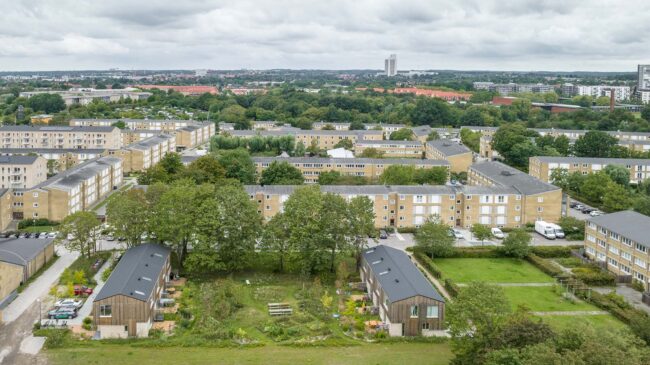
The task involves both renovation of the center, landscaping of the immediate surrounding area of the center, as well as a user process. The existing local center must be demolished down to the foundation, and the new one will be built within the existing foundation, which will be reused.
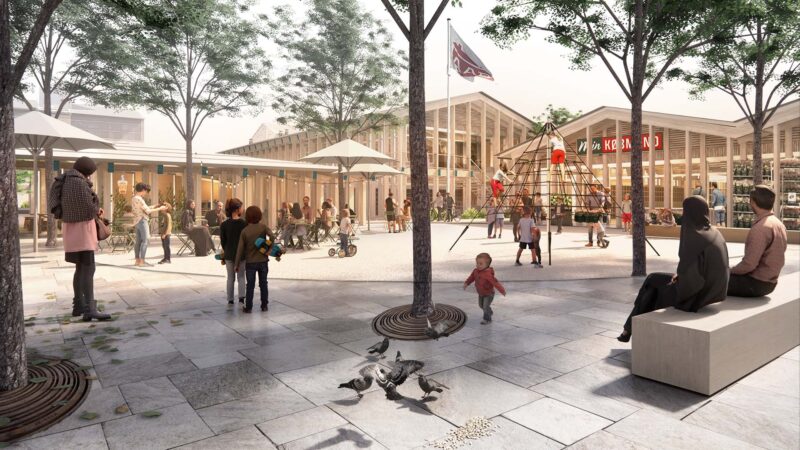
The local center is an important place for the department - it is here that residents can go to take care of practical matters and gather for events and activities for both large and small groups. In the future, the center should more prominently signal that it is a meeting place for people of many different ages and cultures, and be more inviting to accommodate a variety of initiatives.
Main idea
We have chosen to focus on four individual principles that aim to ensure a coherent urban structure that fits into the large courtyard while at the same time can be arranged according to the users’ needs and wishes..
1_ The crossing
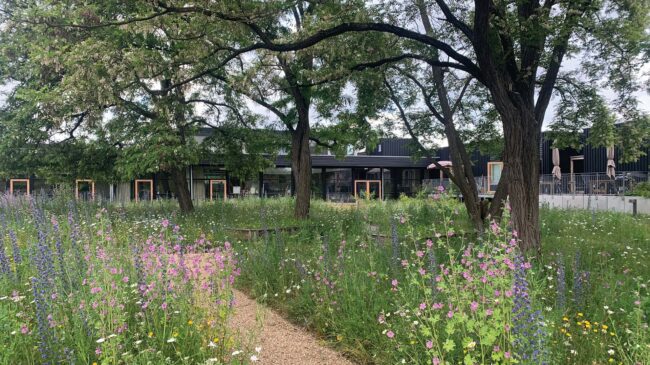
The alley, which today connects the three large courtyards of Vejleåparken and provides access to institutions and functions in the large landscape spaces, must be supported, and the local center must be future-proofed so that it can accommodate local everyday life, associations, and business in the future. New paving, better lighting, and open, inviting facades should elevate the area. We propose a new and more distinct landscape connection that links the northern and southern parts of the courtyard and brings the landscape into the square in the form of trees, water features, and rain gardens. The south side of the courtyard is activated along the edges of the hall with varied landscape spaces, offering room for staying, cultivation, exercise, and chance encounters.
2_Simplification
We propose to gather the area’s functions into three defined building volumes, each under its own roof. Together they create more distinct urban spaces and “clean up” some of the corners and alleys currently experienced in the center. This simplification adds a more distinctive weight to the center’s important functions – a clearer architecture that allows everyday life to unfold freely, while making the functions of the individual buildings easier to read. The building facades are open with glass sections all the way around, so the center does not turn its back or close off from the surrounding landscape spaces.
3_Connection
The edges of the center towards the surrounding homes and garden areas should be “lined” with small events and landscape spaces that offer opportunities for a wide range of functions. Edge zones that create connections and transitions between indoor and outdoor spaces.
4_Transformation
The assumption of “down-renovation” is a positive challenge and, fundamentally, a sustainable starting point. Beyond basements and foundations, we see an exciting potential in preserving what can be preserved of the existing wooden structures and transforming the closed wooden sections in the façades into open glass sections. The construction creates immediate flexibility, allowing the functions of the building to change over time and adapt to evolving needs and uses.
Disposition
The functions are distributed across three main volumes: the Community House, the Grocer, and the Arcade. As a rule, the most outward-facing functions are gathered on the ground floor to activate the façades – not just towards the main street as is currently the case, but along the entire length of the center’s façade. This creates significant security-enhancing effects, as there will be more eyes on the outdoor areas. Additionally, the indoor activities can extend outward and help create an active and vibrant edge zone all the way around the building complex.
Materials and reuse
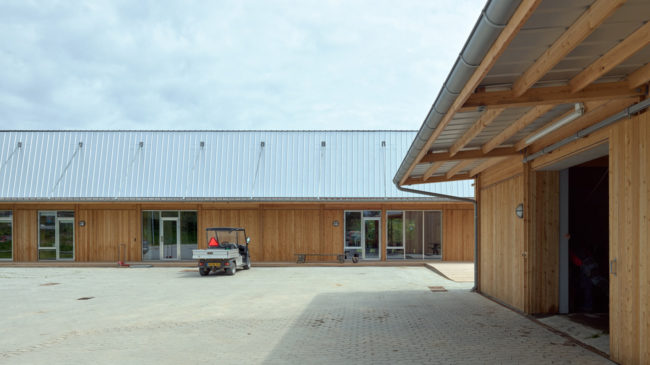
We suggest using, as much as possible, the existing wooden structures, especially in the facade, where we see great potential in reusing the elements. By adding prefabricated wooden frame elements combined with CLT, we will attempt to minimize material consumption. In addition, we propose replacing the wooden panels with glass sections or new wooden panels where shielding is needed.
Vandkunsten serves as the overall consultant, architect, and landscape architect, and we look forward to getting started on the project!
The two other teams that participated in the competition were:
Artelia A/S – Skala architecture a/s
Sweco Architects – Sweco Danmark | OJ A/S