Vandkunsten wins competition about Fingerplan 2.0
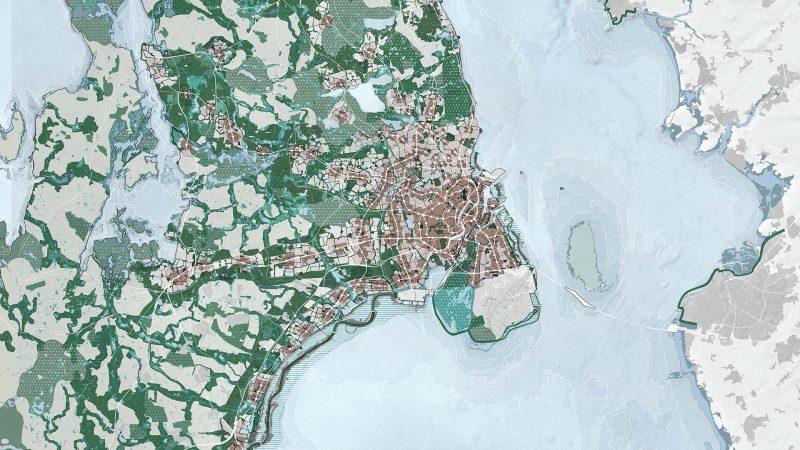
The Fingerplan 2.0 competition is an open idea competition in two phases, announced by the Danish Association of Architects and Dreyer's Foundation. Among the 43 visions submitted in the first phase of the competition, 5 vision proposals, including Vandkunsten's, were selected to proceed to the second phase of the competition.
We would like to take this opportunity to thank the Architects’ Association, the Dreyer Foundation, and all the other generous contributors who have launched this initiative.
Because this just can’t go on any longer!
There is a need for a new narrative and a new perspective on planning, a holistic approach that addresses the major challenges we face in Denmark and the Capital Region. We believe there is clearly a need for a unifying strategy for development in the coming years. A strategy that can create new positive narratives and visions of a future where the major challenges of flooding, CO2 emissions, and the biodiversity crisis have a real impact on urban development. A strategy where we develop new solutions that positively highlight the many potentials inherent in these challenges.
Our project is titled ‘A Decentralized Organism Emerges,’ and in it, we attempt to turn the challenges of rising sea levels, traffic congestion, and lack of life on the outskirts of the capital into opportunities. We propose establishing a new dike from Charlottenlund in the north to Køge in the south, which will serve as protection against the water, while simultaneously creating a new coastal landscape with skerries and reefs, salt marshes, bathing piers, and floating pontoon homes. On land, both forests and the fjord should be allowed to expand, and new attractive residential areas with stilt houses, co-living communities, and tiny houses can emerge.
We are revising the entire way we plan cities and proposing that future development takes place on the terms of water and nature. This involves coastal protection, stopping construction in lowland areas — and in the longer term — retreating from particularly vulnerable areas and coastlines.
The actual finger plan structure with the S-train network is maintained and expanded, with densification near stations and in residential areas. Public transport is strengthened to reduce both congestion and CO2 emissions from car traffic. In addition, a dense network of supercycle routes is established, and express bus connections are introduced across the “fingers”.
We are incredibly proud that our proposal has been selected as the winner of the Fingerplan 2.0 competition and look forward to participating in the ongoing debate and further developing our project in the near future.
Thanks to Anna Aslaug Lund, Peter Stanley, Mats Olsson, Tove Skrumsager, and others for the input!